Blog

Klonopin is prescribed for anxiety, but only one anxiety condition is on its FDA label: panic disorder. The active ingredient, clonazepam, is a benzodiazepine. It calms overactive nerve signaling by strengthening GABA, the brain’s main inhibitory messenger. For people with panic disorder, that can mean fewer or less intense panic attacks. For other forms of anxiety, prescribers sometimes use it off-label. That can be appropriate, but it comes with the same risks of drowsiness, dependence and withdrawal.
This guide explains where Klonopin fits in anxiety treatment, what it can and can’t do, and the questions worth raising with your prescriber.
Anxiety, Panic Disorder and the Difference It Makes
“Anxiety” covers a lot of ground. Feeling nervous before a job interview is a normal human experience. Anxiety disorders are different. They involve fear or worry that’s persistent, hard to control and gets in the way of daily life.
A few anxiety disorders come up most often:
- Panic disorder involves repeated, unexpected panic attacks, along with ongoing worry about future attacks or changes in behavior to avoid them. The FDA label describes a panic attack as a sudden wave of intense fear that peaks within about 10 minutes. It comes with symptoms like a pounding heart, sweating, shaking, shortness of breath, chest discomfort, dizziness or fear of losing control.
- Generalized anxiety disorder (GAD) involves persistent, excessive worry about many everyday things, often with restlessness, muscle tension, poor sleep and trouble concentrating.
- Social anxiety disorder involves intense fear of being judged or embarrassed in social situations.
- Agoraphobia involves fear of places or situations where escape might be hard, and it often occurs alongside panic disorder.
Which condition a person has matters, because treatments are tested and approved for specific diagnoses.
Is Klonopin FDA-Approved for Anxiety?
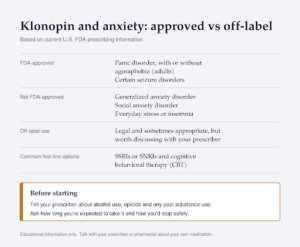
Klonopin is FDA-approved for panic disorder, with or without agoraphobia, in adults. It’s also approved for certain seizure disorders.
It is not FDA-approved for generalized anxiety disorder, social anxiety disorder or general stress. Some other benzodiazepines, such as alprazolam and lorazepam, carry broader anxiety approvals. Our comparison [Klonopin vs Xanax: Key Differences Explained] covers how clonazepam and alprazolam differ.
What off-label use means
Prescribers can legally prescribe a medicine for a condition that isn’t on its label. This is called off-label use, and it’s common in medicine. Clonazepam is sometimes prescribed off-label for generalized or social anxiety.
Off-label doesn’t mean wrong. It does mean the FDA hasn’t reviewed evidence for that specific use, so the prescriber is relying on other research, clinical guidelines and their own judgment. If your prescription is off-label, you may want to ask why this medicine was chosen and how you’ll judge whether it’s helping.
How Klonopin Helps With Panic and Anxiety Symptoms
During a panic attack, the brain’s fear circuits fire off a strong alarm signal, and the body responds as if it’s in danger. Clonazepam strengthens the inhibitory effect of GABA in those circuits, which makes them harder to set off.
In practice, people with panic disorder may notice that attacks come less often or feel less intense. For more on what’s happening in the brain, see [How Does Klonopin Work? Clonazepam Explained].
What the research showed
The FDA label describes two studies of adults with panic disorder, lasting 6 to 9 weeks:
- In a fixed-dose study, 74% of people taking 1 mg a day were free of full panic attacks by the end, compared with 56% on placebo.
- In a flexible-dose study, 62% of people on clonazepam were attack-free, compared with 37% on placebo.
- In both, clonazepam reduced full panic attacks by about one per week more than placebo.
Interestingly, in the fixed-dose study, 1 mg a day worked better than higher doses, which also caused more side effects.
What the research didn’t show
The label notes that clonazepam’s effectiveness beyond about 9 weeks hasn’t been studied in controlled trials, and there’s no clear evidence on how long someone should stay on it. Prescribers are expected to reassess periodically whether it’s still useful.
What Klonopin Can’t Do
Klonopin eases symptoms, but it doesn’t address what’s driving the anxiety. When the medicine is stopped, symptoms can return. During withdrawal, anxiety can even rebound above where it started.
It also isn’t an instant rescue. Clonazepam reaches peak blood levels 1 to 4 hours after a dose, so it doesn’t stop a panic attack within minutes. Our guide [How Long Does Klonopin Take to Work?] covers the timeline.
Where Klonopin Fits in Anxiety Treatment
Treatment guidelines from U.S. professional organizations generally list certain antidepressants as first-line medicines for panic disorder and generalized anxiety disorder. These include selective serotonin reuptake inhibitors (SSRIs), such as sertraline and escitalopram, and serotonin-norepinephrine reuptake inhibitors (SNRIs), such as venlafaxine. Guidelines also recommend cognitive behavioral therapy (CBT), a structured form of talk therapy with strong evidence for anxiety disorders.
Benzodiazepines like clonazepam are often used in more limited ways:
- For a short period while an antidepressant has time to start working, since SSRIs and SNRIs can take several weeks
- For people who haven’t responded to other treatments
- As part of a broader plan that includes therapy
These are general patterns, not rules. Every treatment plan should be built around the individual, including their symptoms, history, other conditions and preferences.
The Trade-Offs to Weigh
Every anxiety medicine has benefits and downsides. For clonazepam, the main trade-offs are these.
Drowsiness and slowed reactions
Sleepiness was the most common side effect in the panic disorder studies, reported by 37% of people on clonazepam compared with 10% on placebo. Dizziness, fatigue, coordination problems and memory trouble were also more common than with placebo. See [Side Effects of Klonopin: Risks and Warnings] for the full picture.
Dependence and withdrawal
With regular use, the body adapts to clonazepam. The FDA label warns that stopping suddenly or reducing the dose quickly can cause withdrawal that may be life-threatening. Withdrawal can include rebound anxiety, panic attacks, insomnia and, in serious cases, seizures. Some people have symptoms that last weeks to more than a year.
Physical dependence can happen with prescribed use. It isn’t the same as addiction, but benzodiazepines can also be misused, and the label warns that addiction can develop even at recommended doses. The risks go up with higher doses and longer use.
Interactions
Combining clonazepam with opioids, alcohol, sleep medicines or other sedatives can dangerously slow breathing. People with anxiety sometimes use alcohol to cope, and that combination is especially risky.
Mood effects
In the panic disorder studies, 7% of people on clonazepam reported depression, compared with 1% on placebo. As an antiepileptic drug, clonazepam also carries a warning about suicidal thoughts. Watch for mood changes, especially early in treatment.
Who Needs Extra Caution
Clonazepam may not be the best fit, or may need extra care, for:
- Older adults. They’re more sensitive to sedation, confusion and falls. The American Geriatrics Society’s Beers Criteria generally advises avoiding benzodiazepines in older adults.
- People with a history of substance use. Past problems with alcohol, prescription medicines or other drugs raise the risk of misuse. Tell your prescriber, even if it was long ago.
- People with breathing problems. COPD and sleep apnea increase the risk of slowed breathing.
- People with liver disease. Significant liver disease is a contraindication.
- People who are pregnant or breastfeeding. Clonazepam can affect newborns and passes into breast milk.
- People with depression or suicidal thoughts. Mood should be monitored closely.
- Anyone under 18. Safety and effectiveness for panic disorder haven’t been established in this age group.
Other Ways to Treat Anxiety
Clonazepam is one option among several, and your prescriber may bring up others, especially if you’re worried about dependence.
Therapy is often the starting point. Cognitive behavioral therapy (CBT) works on the thought patterns that keep anxiety going and helps people slowly get more comfortable with situations they’ve been avoiding. It has strong research support for both panic disorder and generalized anxiety.
Antidepressants in the SSRI and SNRI groups are also widely used for anxiety. You take them every day, and they can take a few weeks to start helping. They don’t carry the kind of dependence risk that benzodiazepines do, although you still shouldn’t stop them without talking to your prescriber first.
Buspirone is another medicine prescribers sometimes use. It’s FDA-approved for generalized anxiety disorder and doesn’t act on the brain the way benzodiazepines do.
Everyday habits count for more than people expect. Steady sleep, regular exercise, cutting back on caffeine and alcohol, and staying in touch with friends and family won’t replace treatment, but they can make it work better.
What helps one person may not help the next, and a lot of people end up using more than one of these together.
Questions to Ask Your Prescriber
Writing a few questions down before your appointment can help you get more out of it. You might ask whether your prescription is for panic disorder or is being used off-label for a different kind of anxiety. It’s also reasonable to ask how long they expect you to stay on clonazepam and what the longer-term plan looks like.
Other good questions are how the two of you will tell whether it’s working, what stopping would involve if you decide to later, and whether anything else you take, including supplements, could interact with it.
When to Get Help
Call 911 if someone taking clonazepam is breathing slowly or shallowly, can’t be woken up or has a seizure. If you have questions about someone taking too much, Poison Help is at 1-800-222-1222.
If you or someone close to you is thinking about suicide, call or text 988 to reach the 988 Suicide & Crisis Lifeline.
Get in touch with your prescriber if your anxiety is getting worse, your mood changes in a way that worries you, side effects are getting in the way of daily life, or you’re thinking about stopping.
Frequently Asked Questions
Is Klonopin good for anxiety?
It’s FDA-approved for panic disorder and works for many people with it. For other kinds of anxiety it’s prescribed off-label, and most guidelines suggest starting with therapy or an antidepressant.
Is Klonopin approved for generalized anxiety disorder?
No. Its approvals are for panic disorder and certain seizure disorders, so using it for GAD is off-label.
Can I take Klonopin only when I feel anxious?
Some prescribers set it up that way, and others prescribe a regular schedule. Go by your prescription. Keep in mind that clonazepam takes a while to kick in and stays in your body for days.
Is Klonopin better than an SSRI?
They’re different tools. SSRIs take a few weeks to help but don’t carry the same dependence risk. Your prescriber can walk you through which makes more sense for you.
Can Klonopin make anxiety worse?
Sometimes. A small number of people become agitated instead of calmer, and anxiety can come back stronger during withdrawal. Tell your prescriber if things get worse.
How long can I stay on Klonopin for anxiety?
There isn’t a fixed limit. According to the label, long-term use hasn’t been tested in controlled trials, so your prescriber should check in with you about it regularly.
Is Klonopin addictive?
Your body can become dependent on it with regular use, and addiction can happen even at prescribed doses. Higher doses and longer use make both more likely.
Medical Disclaimer
This article is for general education only and does not replace advice from your doctor, pharmacist or another qualified healthcare provider. It isn’t meant to diagnose any condition. Please don’t start, stop or change any medication without talking to your prescriber first. If you think someone is having a medical emergency, call 911.
Sources and References
- U.S. Food and Drug Administration / DailyMed. Klonopin (clonazepam) tablets, prescribing information (Indications and Usage, Clinical Trials, Warnings, Adverse Reactions). https://dailymed.nlm.nih.gov/dailymed/lookup.cfm?setid=cfa0d79a-843c-4b88-95a1-e9511d649ca1
- National Institute of Mental Health. Anxiety Disorders. nimh.nih.gov
- American Psychiatric Association. Practice Guideline for the Treatment of Patients With Panic Disorder. psychiatry.org
- American Geriatrics Society. Beers Criteria for Potentially Inappropriate Medication Use in Older Adults (2023 update).
- MedlinePlus (National Library of Medicine). Clonazepam. https://medlineplus.gov/druginfo/meds/a682279.html
- 988 Suicide & Crisis Lifeline. 988lifeline.org