Blog

Clonazepam, the medicine in Klonopin, clears out of the body slowly. The FDA label puts its half-life at 30 to 40 hours, so if you took a tablet on Monday morning, roughly half would still be in your bloodstream late Tuesday. Most people have gotten rid of the bulk of it about a week after their final dose, and for some people it takes a bit longer than that.
What people usually notice from a dose, feeling calmer or drowsy, tends to fade within several hours. There’s a gap of days between when you stop feeling it and when it’s actually out of your system. That gap is the reason it matters for driving, alcohol, new prescriptions and stopping the medication.
Half-life, in plain words
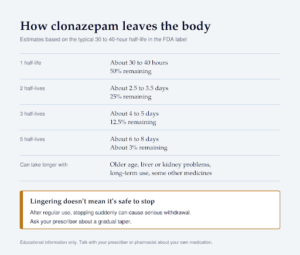
A drug’s half-life is how long your body takes to get rid of half of it. With clonazepam that’s about 30 to 40 hours, and it repeats: half of what’s left disappears in the next 30 to 40 hours, and so on. By five half-lives, around 3% remains, and doctors and pharmacists generally treat that as cleared.
| Since your last dose | About how much is left |
| 30 to 40 hours | Half |
| 2.5 to 3.5 days | A quarter |
| 4 to 5 days | An eighth |
| 6 to 8 days | Around 3% |
These estimates use the typical half-life from the FDA label. Your timing may be different.
The 30- to 40-hour figure is typical, not universal. Some references report half-lives below 20 hours in some people and above 60 in others, so your own numbers could be quite different from the table.
You feel it for hours. It stays for days.
If you take clonazepam in the evening, you’ll probably feel its effects that night and very little by the next afternoon. Even so, most of that dose, likely around three-quarters, is still in your blood when you wake up. It hasn’t been in your body long enough to lose half yet.
This leftover amount is why people can be slower to react the morning after an evening dose without realizing it. It also explains why levels keep rising for the first several days when you take it daily, because each new tablet adds to what remains from earlier ones before levels settle. Alcohol or a sleep aid taken the next day can combine with it as well.
We cover the first few hours and the first week in more detail in [How Long Does Klonopin Take to Work?].
Where it goes
Nearly all of it is processed by the liver. The label says under 2% leaves the body in urine without being changed first.
In the liver, clonazepam is converted to 7-aminoclonazepam, which is then broken down further, largely by enzymes from the CYP3A group. What remains after that is removed by the kidneys.
The label also mentions that about 85% of the clonazepam in your blood is attached to proteins, which is one reason it leaves slowly. Dose size doesn’t change the half-life. A 2 mg tablet clears at the same proportional rate as a 0.5 mg tablet, and there’s just more drug to clear.
Things that can slow it down (or speed it up)
Getting older can slow clearance. The label says age hasn’t been studied directly, but older adults are more likely to have slower livers and kidneys, so it asks prescribers to dose carefully. Older people also tend to feel benzodiazepines more.
Liver disease is a big one. If your liver can’t keep up, clonazepam builds up. Per the label, people with significant liver disease shouldn’t take it.
Kidney problems matter too, since the kidneys remove the breakdown products. The label asks for caution.
Some medicines change your levels. Four seizure drugs, phenytoin, carbamazepine, lamotrigine and phenobarbital, can drop clonazepam levels by about 38%. Antifungal pills like fluconazole may raise them. Starting or stopping one of these can change things without you noticing, so check with us or your prescriber first.
How long you’ve been taking it counts as well. One tablet clears on about the timeline above. Months of daily use means you’re starting from a higher level, so it takes longer.
“It leaves slowly, so can’t I just stop?”
No. This one really matters.
If you’ve been taking clonazepam regularly, your brain has adjusted to it. Stop suddenly, or drop the dose fast, and your brain doesn’t have time to catch up. The FDA label warns this can cause withdrawal reactions that may be life-threatening, including seizures. People with epilepsy can go into status epilepticus, a seizure that won’t stop without emergency care.
Because clonazepam fades slowly, withdrawal might not start for a few days. By then, people don’t always connect it to stopping. Watch for anxiety, trouble sleeping, irritability, shaking, sweating and a fast heartbeat. In serious cases, seizures or hallucinations can happen.
Sometimes it drags on. The label describes protracted withdrawal lasting weeks, occasionally more than a year.
Your prescriber can set up a slow taper that fits your dose and history. We don’t post taper schedules online, because what’s safe for one person may not be safe for another.
About drug tests
If you have a prescription, say so. Tell the lab or whoever ordered the test. Many workplace programs send positive results to a medical review officer, a doctor who checks prescriptions with your pharmacy or prescriber.
How long it shows up depends on the kind of test (hair looks back much further than urine or blood), the lab’s cutoffs, your dose and how long you’ve been taking it. It varies too much to give you a single number, so we don’t list one. We can help you get your prescription records together if you need them.
Day-to-day reminders
- Driving: Wait until you know how your dose hits you, and include the morning after.
- Alcohol: Skip it. The label says to avoid it, and a missed dose doesn’t mean you’re clear.
- New prescriptions: Tell any doctor or dentist about your clonazepam before taking an opioid, sleep aid or muscle relaxant, even if you stopped recently. Breathing can slow dangerously.
- Surgery: Give the team your dose and when you last took it. Don’t stop beforehand without asking.
- Pregnancy and breastfeeding: Clonazepam reaches the baby before birth and through breast milk. Late-pregnancy use can leave newborns sedated or in withdrawal. Talk to your prescriber before changing anything.
When to get help
Call 911 if someone on clonazepam is breathing slowly or shallowly, won’t wake up, has blue or gray lips, or has a seizure. Poison Help is 1-800-222-1222.
Call your prescriber if you have withdrawal symptoms, are still groggy late into the next day, or feel your mood slipping. If you’re thinking about suicide, call or text 988 now.
Frequently Asked Questions
What’s the half-life of Klonopin?
30 to 40 hours is typical, per the FDA label. It varies.
How long until it’s all out of my body?
Most of it is out in about 6 to 8 days. It can take longer if you’re older, have liver problems or have taken it for a long time.
How long does one dose stay in my system?
Days. You’ll just stop feeling it after a few hours.
Why do I still feel it the next day?
Most of an evening dose is still in your blood the next morning. If it affects driving or work, tell your prescriber.
Does a higher dose stay longer?
The half-life is the same at any dose. There’s just more to clear.
When does withdrawal start?
Often a few days after the last dose. It can be serious, so plan any change with your prescriber.
Can I drink the day after my last dose?
Better not. It’s still in your system, and alcohol adds to it.
Will it show up on a drug test?
Possibly. If you have a prescription, tell the lab or medical review officer.
Medical Disclaimer
This article is for general education only and does not replace advice from your doctor, pharmacist or other healthcare provider. Clearance times are estimates and vary from person to person. Do not start, stop or change any medication without talking to your prescriber. In an emergency, call 911.
Sources and References
- U.S. Food and Drug Administration / DailyMed. Klonopin (clonazepam) tablets, prescribing information. https://dailymed.nlm.nih.gov/dailymed/lookup.cfm?setid=cfa0d79a-843c-4b88-95a1-e9511d649ca1
- MedlinePlus (National Library of Medicine). Clonazepam. https://medlineplus.gov/druginfo/meds/a682279.html
- National Library of Medicine, StatPearls. Clonazepam; Drug Elimination; Biochemistry, Cytochrome P450. NCBI Bookshelf.
- National Library of Medicine, LactMed. Clonazepam. https://ncbi.nlm.nih.gov/books/n/lactmed/LM344
- Substance Abuse and Mental Health Services Administration. Medical Review Officer Guidance Manual for Federal Workplace Drug Testing Programs. samhsa.gov