Blog

Klonopin and Xanax are two of the best-known benzodiazepines in the U.S., and people often wonder how they differ. Both work the same basic way: they strengthen the effect of GABA, which quiets overactive nerve signaling. They differ in what they’re approved to treat, how fast the body clears them, the forms they come in and some of their drug interactions.
This comparison sticks to documented facts from U.S. prescribing information. It doesn’t rank the two drugs. The better fit depends on the person, and that’s a decision for a prescriber who knows your full history.
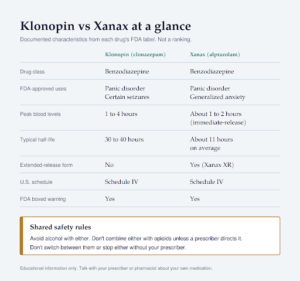
Klonopin vs Xanax at a Glance
This table provides a detailed comparison of Klonopin vs Xanax.
| Klonopin (clonazepam) | Xanax (alprazolam) | |
| Drug class | Benzodiazepine | Benzodiazepine |
| FDA-approved uses | Panic disorder (with or without agoraphobia); certain seizure disorders | Generalized anxiety disorder; panic disorder (with or without agoraphobia) |
| Time to peak blood levels | 1 to 4 hours | About 1 to 2 hours (immediate-release) |
| Typical elimination half-life | 30 to 40 hours | About 11 hours on average in healthy adults |
| Main breakdown pathway | Liver, including CYP3A | Liver, mainly CYP3A4 |
| Forms available | Tablets; generic orally disintegrating tablets | Immediate-release and extended-release tablets; generic orally disintegrating tablets and oral solution |
| U.S. controlled substance schedule | Schedule IV | Schedule IV |
| FDA boxed warning | Yes | Yes |
Figures come from each drug’s FDA prescribing information and vary between individuals.
How They’re Alike
It’s worth starting with what the two drugs share, because it’s a lot.
Both are benzodiazepines. Both bind to the same site on GABA-A receptors and make those receptors respond more strongly to GABA. That’s why they share many of the same effects, including reduced anxiety and panic, drowsiness, slower reaction time, coordination problems and memory effects. For a deeper look at this mechanism, see [How Does Klonopin Work? Clonazepam Explained].
Both are Schedule IV controlled substances under federal law. That limits refills and means prescriptions are tracked through state monitoring programs.
Both carry the same FDA boxed warning, which was required for all benzodiazepines in 2020. It covers the danger of combining them with opioids, the risk of abuse, misuse and addiction, and the risk of dependence and withdrawal.
Both can cause serious withdrawal if stopped suddenly after regular use.
What Each One Is Approved to Treat
Both drugs are FDA-approved for panic disorder, with or without agoraphobia.
Beyond that, their approvals split. Xanax (immediate-release alprazolam) is approved for generalized anxiety disorder, and Klonopin is not. Klonopin is approved for certain seizure disorders, including Lennox-Gastaut syndrome, akinetic and myoclonic seizures, and some absence seizures. Xanax is not approved for seizures.
The extended-release form, Xanax XR, is approved for panic disorder only.
Prescribers sometimes use either drug off-label for other conditions. If that’s the case for you, it’s reasonable to ask why that medicine was chosen. Our article [Klonopin for Anxiety: What Patients Need to Know] covers off-label use in more detail.
How Fast They Start Working
According to their labels, immediate-release alprazolam typically reaches peak blood levels within 1 to 2 hours. Clonazepam reaches peak levels within 1 to 4 hours.
Both are absorbed well from the gut, and many people notice effects from either one within the first hour. Timing varies a lot from person to person, so the ranges overlap. Neither should be thought of as an instant fix for a panic attack.
Xanax XR releases alprazolam slowly, so it peaks later than the regular tablet and its effect is more even through the day.
You can read more about clonazepam’s timing in [How Long Does Klonopin Take to Work?].
How Long Each One Stays in Your Body
If you remember one difference between these two drugs, make it this one.
According to the Xanax label, alprazolam’s half-life averages around 11 hours in healthy adults, though it can be anywhere from about 6 to 27 hours. It usually runs longer in older adults, in people with obesity and in people with liver disease. The Klonopin label gives clonazepam a typical half-life of 30 to 40 hours, roughly three times as long.
You can see that gap in how the drugs are usually prescribed. Regular alprazolam is often taken a few times a day for panic disorder, while clonazepam is more often taken once or twice. Your own prescription may be set up differently.
It also shapes how the day feels. Alprazolam levels go up and down more between doses, and some people feel their symptoms creeping back before the next one is due. Clonazepam holds steadier, but it builds up over several days, and it’s more likely to leave you groggy the next morning.
Stopping plays out differently too. After regular use, both need a slow taper. Since alprazolam clears faster, withdrawal can start sooner after a missed or final dose. With clonazepam it may not show up for a few days. Neither one is safe to stop all at once.
There’s more on clonazepam’s clearance in [How Long Does Klonopin Stay in Your System?].
Drug Interactions
The most dangerous interactions are the same for both: opioids, alcohol, other benzodiazepines, sleep medicines and anything else that makes you drowsy. Mixing either drug with these can deepen sedation and slow your breathing.
Where they differ is in how the liver handles them.
Alprazolam depends heavily on a liver enzyme called CYP3A4. When a strong blocker of that enzyme is in the picture, alprazolam levels can shoot up. That’s why the Xanax label says not to use it with strong CYP3A inhibitors such as ketoconazole or itraconazole. Ritonavir is an exception, but it has to be managed carefully. Some antibiotics, antifungals, HIV medicines and even grapefruit juice can raise alprazolam levels too.
Clonazepam also relies on CYP3A enzymes, though the label’s wording is milder. It advises caution with antifungal pills like fluconazole, which may push clonazepam levels up. It also says that some seizure medicines, including phenytoin, carbamazepine, lamotrigine and phenobarbital, can lower clonazepam levels by about 38%.
These interactions are easy to overlook, so ask a pharmacist to go through everything you take, supplements and over-the-counter products included.
Who Shouldn’t Take Them
The two labels rule out slightly different people.
Klonopin isn’t for anyone allergic to benzodiazepines, anyone with significant liver disease, or anyone with acute narrow-angle glaucoma.
Xanax isn’t for anyone allergic to alprazolam or other benzodiazepines, or anyone taking a strong CYP3A inhibitor like ketoconazole or itraconazole.
With either drug, prescribers take extra care with older adults, people who have lung disease or sleep apnea, people with a past history of substance use, and people who are pregnant or breastfeeding. Neither drug has been shown safe and effective for panic disorder in anyone under 18.
Forms Available
Brand-name Klonopin comes only as tablets you swallow, in 0.5 mg, 1 mg and 2 mg strengths. Generic clonazepam also comes as a tablet that dissolves on the tongue.
Alprazolam has more choices. There’s the regular tablet, the extended-release Xanax XR, generic versions of both, plus generic dissolving tablets and a liquid. Which form someone gets can change how often they take it and how smooth the effect is across the day.
Side Effects Compared
Since they act on the brain the same way, the two share most of their side effects. Drowsiness, dizziness, tiredness, clumsiness, memory trouble and slower thinking are the ones people run into most with either drug. Once in a while, either one can have the opposite of the intended effect and cause agitation or irritability.
Klonopin has a few extras because it’s also a seizure medicine. It carries the antiepileptic warning about suicidal thoughts and behavior, it can increase saliva, and in people who have more than one type of seizure it sometimes makes certain seizures worse.
For the full rundown on clonazepam, see [Side Effects of Klonopin: Risks and Warnings].
Which Is Stronger?
It’s a common question, but strength isn’t a helpful way to compare these two. Both are high-potency benzodiazepines, which just means a small number of milligrams has a real effect. One milligram of alprazolam doesn’t equal one milligram of clonazepam, and because they last such different lengths of time, they also feel different over the course of a day.
When someone switches from one to the other, prescribers work from rough conversion estimates and then adjust for the person. We’ve left those numbers out on purpose. A switch should only happen with your prescriber guiding it, usually gradually.
Is One More Addictive Than the Other?
On paper, they carry identical FDA boxed warnings about abuse, misuse, addiction, dependence and withdrawal. Some research and clinical sources suggest that coming off alprazolam can be harder for some people, possibly because it leaves the body faster. But for any one person, the bigger factors are the dose, how long they’ve been taking it, and whether they or their family have a history of substance use.
Either drug can lead to dependence even when taken exactly as prescribed, and stopping either one suddenly can cause dangerous withdrawal.
How Prescribers Choose Between Them
There isn’t a single rule. A prescriber will usually start with the diagnosis and whether either drug is approved for it. From there they think about whether the person needs steady coverage all day or something shorter, and they look at age, liver health and any breathing problems. Other medications and any history of substance use come into it too.
A prescriber might also ask whether a benzodiazepine should be the main treatment in the first place. Sometimes it makes more sense as a short-term bridge while therapy or an antidepressant takes on the longer-term work. What you prefer, and how other medications have gone for you in the past, are part of the decision too.
If you were prescribed one of these and you’re wondering about the other, ask your prescriber what led them to their choice. Most will be glad to explain, and you’ll come away understanding your own treatment better.
When to Get Help
If someone on either medicine has slow or shallow breathing, can’t be woken, has lips turning blue or gray, or has a seizure, call 911 right away. For questions about a possible overdose, you can reach Poison Help at 1-800-222-1222.
Anyone having thoughts of suicide can call or text 988, any time of day.
Frequently Asked Questions
What’s the main difference between Klonopin and Xanax?
The length of time each one stays in your body. Clonazepam has a half-life of 30 to 40 hours, compared with about 11 hours on average for alprazolam. They’re also approved for different conditions.
Is Klonopin or Xanax better for anxiety?
Neither one wins across the board. Xanax carries approvals for generalized anxiety disorder and panic disorder, while Klonopin’s cover panic disorder and seizures. Your prescriber is the best person to say which suits you.
Which one is better for panic attacks?
Both have FDA approval for panic disorder. Alprazolam tends to reach its peak a little faster, and clonazepam gives steadier levels over the day. People respond differently to each.
Can I take Klonopin and Xanax together?
Not unless your prescriber has specifically told you to. Combining two benzodiazepines adds up the sedation and raises the chance of dangerously slow breathing.
Which one lasts longer?
Clonazepam. You’ll usually feel it longer, and it also takes longer to leave your system.
Can I switch from Xanax to Klonopin?
Yes, but with your prescriber in charge of it. Doses don’t convert one-to-one, and the change is usually made gradually so you don’t go into withdrawal.
Are they in the same drug class?
They are. Both are benzodiazepines, and both are Schedule IV controlled substances.
Do they show up the same way on drug tests?
That varies with the type of test and the lab doing it. Either way, if you have a prescription, let the lab or medical review officer know.
Medical Disclaimer
The information here is for general education and isn’t a substitute for advice from your own doctor, pharmacist or other healthcare provider. It lays out documented facts about two medicines without recommending either one. Talk to your prescriber before you start, stop, switch or change the dose of any medication. In a medical emergency, call 911.
Sources and References
- U.S. Food and Drug Administration / DailyMed. Klonopin (clonazepam) tablets, prescribing information. https://dailymed.nlm.nih.gov/dailymed/lookup.cfm?setid=cfa0d79a-843c-4b88-95a1-e9511d649ca1
- U.S. Food and Drug Administration / DailyMed. Xanax (alprazolam) tablets, prescribing information. dailymed.nlm.nih.gov
- U.S. Food and Drug Administration / DailyMed. Xanax XR (alprazolam) extended-release tablets, prescribing information. dailymed.nlm.nih.gov
- U.S. Food and Drug Administration. Benzodiazepine class Boxed Warning update, Drug Safety Communication (September 2020). fda.gov
- U.S. Drug Enforcement Administration. Benzodiazepines drug fact sheet. dea.gov
- MedlinePlus (National Library of Medicine). Clonazepam; Alprazolam. medlineplus.gov