
Blog

There isn’t one standard Klonopin dose. How much clonazepam a person takes depends on why it was prescribed, their age, their other medicines, how they respond to the first few doses and how well they tolerate side effects. The FDA label gives prescribers starting points, target doses and upper limits, then asks them to adjust for the individual.
This guide explains what those label numbers are and what they mean in practice. It’s meant to help you understand your prescription and have a better conversation with your prescriber. It isn’t a substitute for their instructions, and the doses below should never be used to change your own treatment.
How Klonopin Doses Are Decided
A prescriber usually thinks about a few things before choosing a clonazepam dose.
The first is the condition. Klonopin is FDA-approved for panic disorder and for certain seizure disorders, and the label treats them separately. Panic disorder doses are generally much lower than seizure doses.
The second is the person. Age, body weight (especially in children), liver and kidney function, breathing problems and any history of substance use all affect how much is appropriate. Someone in their 70s may be very sensitive to a dose that a 30-year-old barely notices.
The third is everything else the person takes. Opioids, alcohol, sleep medicines, other seizure drugs and some antidepressants add to clonazepam’s sedating effect. Certain seizure medicines, including phenytoin, carbamazepine and phenobarbital, can speed up clonazepam’s breakdown. The label says they can lower blood levels by about 38%.
Finally, prescribers watch the response. With clonazepam, doses are usually increased in small steps a few days apart. This gives the drug time to build up and lets side effects be caught early.
Klonopin Tablet Strengths
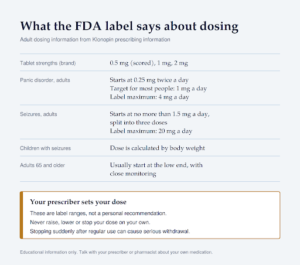
Brand-name Klonopin comes as oral tablets in three strengths:
- 0.5 mg, an orange tablet that’s scored so it can be split
- 1 mg, a blue tablet that isn’t scored
- 2 mg, a white tablet that isn’t scored
The label says to swallow the tablets whole with water. Generic clonazepam tablets come in the same strengths. Generic clonazepam is also available as orally disintegrating tablets that dissolve on the tongue, in several smaller strengths.
Generic tablets can look different from brand-name Klonopin and from one generic manufacturer to the next. If your refill looks different than usual, ask your pharmacist before taking it. It’s a common and quick check.
Klonopin Dosage for Panic Disorder
The FDA label describes the following for adults with panic disorder:
- Starting dose: 0.25 mg twice a day.
- Target dose: 1 mg a day for most patients, which may be reached after 3 days.
- Maximum dose: 4 mg a day.
One finding from the original studies surprises many people. In a fixed-dose trial, 1 mg a day worked best. Doses of 2, 3 and 4 mg a day were less effective in that study and caused more side effects. The label still allows higher doses because some individuals may benefit. When prescribers do go higher, the label describes small increases every 3 days until symptoms are controlled or side effects get in the way.
Drowsiness is the most common complaint at the start. The label notes that taking one of the doses at bedtime may help with daytime sleepiness. Whether that makes sense for you is your prescriber’s call.
The label also points out that clonazepam’s long-term effectiveness for panic disorder, beyond about 9 weeks, hasn’t been tested in controlled trials. Prescribers who keep patients on it longer are expected to check in periodically on whether it’s still helping. Safety and effectiveness for panic disorder haven’t been established in people under 18.
Klonopin Dosage for Seizure Disorders
Seizure treatment takes a slower, more gradual approach, and the doses go much higher.
Adults
For adults, the label says the starting dose shouldn’t exceed 1.5 mg a day, split into three doses. From there, the dose may be raised by 0.5 to 1 mg every 3 days. Increases continue until seizures are controlled or side effects prevent going higher. The maintenance dose is individualized, and the label’s maximum is 20 mg a day.
If you already take other seizure medicines, your neurologist will factor them in. The label warns that using several anticonvulsants together can add to drowsiness and other central nervous system side effects.
Children
For infants and children up to 10 years old or 30 kg (about 66 pounds), the label bases doses on body weight. It starts low to limit drowsiness and increases slowly, no faster than every third day. When possible, the daily amount is split into three equal doses. If the doses can’t be equal, the largest one is given at bedtime.
Children’s doses need careful calculation by the prescriber and pharmacist. Please don’t try to work out a child’s dose from adult tablets or from information online.
When seizure control changes
Some people lose part of clonazepam’s anti-seizure benefit over time. According to the label, up to 30% of patients who first responded lost some of that effect, often within 3 months. A dose adjustment sometimes restores it. In people who have more than one seizure type, clonazepam can occasionally make generalized tonic-clonic (grand mal) seizures more frequent. Tell your neurologist about any change in seizure pattern right away.
Klonopin Dosage for Older Adults
The label doesn’t give a separate number for adults 65 and older. It says dosing should be cautious, usually starting at the low end of the range with close monitoring. Older adults are more likely to have reduced liver or kidney function and to take several medicines. They’re also more prone to confusion, over-sedation and falls.
The American Geriatrics Society’s Beers Criteria, a widely used list of medicines that can be risky for older adults, generally advises avoiding benzodiazepines in this age group. That doesn’t mean clonazepam is never used. It means the benefits need to clearly outweigh the risks, and family members should watch for unsteadiness or new confusion.
Is There a “Safe” Klonopin Dose?
No dose is risk-free. Even at prescribed amounts, the FDA’s boxed warning for all benzodiazepines covers abuse, misuse, addiction, physical dependence, withdrawal, and the danger of combining them with opioids.
What the label does make clear is that risk climbs with dose and time. The chance of dependence and withdrawal goes up with higher daily doses and longer treatment. That’s one reason prescribers aim for the lowest dose that works and reassess regularly.
A dose that’s appropriate for one person can be dangerous for another. That’s especially true for someone who drinks alcohol, takes an opioid, has sleep apnea or lung disease, or is older.
What If a Dose Doesn’t Seem to Be Working?
Clonazepam takes time. Blood levels peak 1 to 4 hours after a dose, and with regular use, it takes several days for levels to settle. In the panic disorder studies, results were measured over weeks, not days. More on timing is in our guide [How Long Does Klonopin Take to Work?].
If you feel your dose isn’t helping, don’t take extra. Doubling up or taking doses closer together can cause heavy sedation, particularly because earlier doses are still in your system. Contact your prescriber instead. They may adjust the dose, change the timing or look at other treatment options.
The same applies if a dose that used to work seems to be wearing off. That can be a sign of tolerance, and it’s a conversation to have with your prescriber rather than something to fix on your own.
What to Do If You Miss a Dose
General guidance from MedlinePlus is to take a missed dose as soon as you remember. If it’s almost time for your next dose, skip the missed one and go back to your regular schedule. Don’t take a double dose to make up for it.
If you miss doses often, or you’ve missed several in a row, call your prescriber or pharmacist. Missing multiple doses can sometimes trigger withdrawal symptoms. For people with epilepsy, it can also cause breakthrough seizures.
Signs You May Have Taken Too Much
Taking more clonazepam than prescribed can cause extreme drowsiness, confusion, slurred speech, poor coordination, weak reflexes and, in severe cases, slowed breathing and coma. The danger is much higher when clonazepam is combined with opioids, alcohol or other sedating drugs.
If someone has slow or shallow breathing, can’t be woken, or has blue or gray lips, call 911 right away. For questions about a possible overdose in someone who is awake and breathing normally, contact Poison Help at 1-800-222-1222.
Changing or Stopping Your Klonopin Dose
After regular use, clonazepam should never be stopped suddenly or cut down quickly without medical guidance. The FDA label warns that doing so can cause acute withdrawal reactions that may be life-threatening, including seizures. For people with epilepsy, stopping suddenly can also trigger status epilepticus, a seizure that doesn’t stop.
The label calls for a gradual taper using a plan built for the individual patient. If withdrawal symptoms appear during a taper, prescribers may pause it, return to the previous dose, and then continue more slowly. Some people have withdrawal symptoms that last weeks or even more than a year, which the label calls protracted withdrawal syndrome.
We don’t publish taper schedules. Tapering needs to be planned around your dose, how long you’ve taken clonazepam, your medical history and how you respond along the way. Your prescriber is the right person to set that plan, and your pharmacist can help you understand it and stay on track.
Tips for Taking Klonopin Safely
A few habits make it easier to take clonazepam exactly as prescribed:
- Use a pill organizer or phone reminder, especially if you take more than one dose a day.
- Keep a simple log of when you take each dose if your schedule changes often.
- Store tablets somewhere secure and out of reach of children and visitors. Clonazepam is a controlled substance, and giving it to someone else is illegal.
- Fill all your prescriptions at one pharmacy so interactions are easier to catch.
- Don’t drink alcohol while taking clonazepam. The label advises avoiding it.
- Hold off on driving until you know how your dose affects you. Reaction time can be slower even when you feel alert.
- Bring leftover tablets to a drug take-back site or ask our pharmacist about safe disposal
Questions to Ask Your Prescriber About Your Dose
It can help to write these down before your appointment:
- What is this dose meant to treat, and how will we know it’s working?
- When should I take it, and does timing matter for side effects?
- What should I do if I still have symptoms?
- How long do you expect me to take it?
- Which of my other medicines or supplements could interact with it?
- If I want to stop in the future, how would we do that safely?
Frequently Asked Questions
What is the usual Klonopin dose for panic disorder?
According to the FDA label, adults usually start at 0.25 mg twice a day. Most reach a target of 1 mg a day after about 3 days. Your prescriber decides what’s right for you.
What is the maximum dose of Klonopin?
The label lists a maximum of 4 mg a day for panic disorder and 20 mg a day for seizure disorders in adults. Reaching the maximum is not the goal, and many people take much less.
Is 0.5 mg of Klonopin a lot?
It depends on the person and the condition. For some it’s a typical dose. For others, especially older adults, it can cause noticeable drowsiness. Only your prescriber can judge whether a dose fits you.
Can I take Klonopin only when I need it?
Some prescribers direct as-needed use, while others prescribe a regular schedule. Follow the directions on your prescription, and ask your prescriber before changing how you take it.
Can I cut Klonopin tablets in half?
The 0.5 mg brand tablet is scored for splitting. The 1 mg and 2 mg brand tablets aren’t scored. Ask your pharmacist before splitting any tablet, since generic products differ.
What happens if I take two doses by mistake?
You may feel very drowsy or unsteady. Avoid driving and alcohol, and call your pharmacist or Poison Help at 1-800-222-1222 for advice. Call 911 if breathing slows or the person can’t be woken.
Can my dose be lowered if I feel too sleepy?
Possibly. Tell your prescriber, who may adjust the dose or timing. Don’t reduce it on your own, particularly if you’ve been taking it regularly.
How is Klonopin stopped safely?
With a gradual taper planned by your prescriber. Stopping suddenly after regular use can cause dangerous withdrawal, including seizures.
Medical Disclaimer
This article is for general educational purposes only and does not replace advice from your doctor, pharmacist or other qualified healthcare provider. The doses described come from U.S. FDA prescribing information and are not a recommendation for any individual. Do not start, stop or change the dose of any medication without talking to your prescriber. If you think you or someone else is having a medical emergency, call 911.
Sources and References
- U.S. Food and Drug Administration / DailyMed. Klonopin (clonazepam) tablets, prescribing information and Medication Guide. https://dailymed.nlm.nih.gov/dailymed/lookup.cfm?setid=cfa0d79a-843c-4b88-95a1-e9511d649ca1
- MedlinePlus (National Library of Medicine). Clonazepam. https://medlineplus.gov/druginfo/meds/a682279.html
- American Geriatrics Society. Beers Criteria for Potentially Inappropriate Medication Use in Older Adults (2023 update). Journal of the American Geriatrics Society.
- U.S. Food and Drug Administration. Benzodiazepine class Boxed Warning update, Drug Safety Communication (September 2020). fda.gov
- Poison Help, Health Resources and Services Administration. 1-800-222-1222.